Beyond the Tick-Box: Why COFI Readiness Is Your New Competitive Advantage
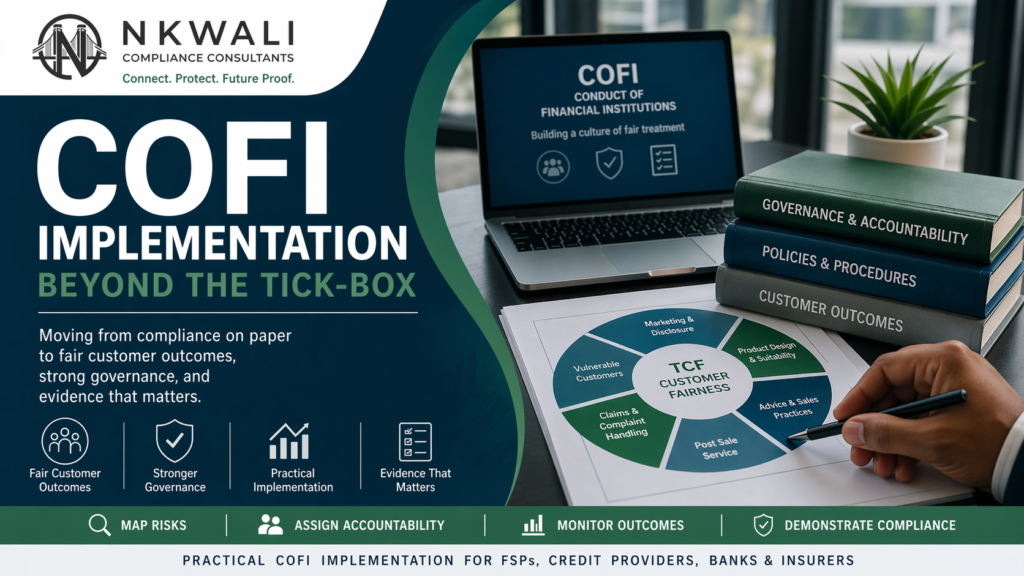

Beyond the Tick-Box: Why COFI Readiness is Your New Competitive Advantage
COFI readiness is no longer just about having documents in place. Instead, it is about proving fair customer outcomes, stronger governance, and defensible conduct oversight.
Why the old compliance logic is no longer enough
For more than two decades, compliance in the South African financial sector operated on a familiar logic: identify the rule, document a policy, tick the box, and move on. It worked — after a fashion. Regulators had a list of requirements, while institutions had a list of responses. As a result, the gap between what the policy said and what customers actually experienced was not always the examiner’s main concern.
However, that logic is ending.
The Conduct of Financial Institutions (COFI) Bill, developed under South Africa’s Twin Peaks regulatory architecture, represents a fundamental shift in how the Financial Sector Conduct Authority (FSCA) will assess compliance. In other words, the question is no longer whether a policy exists. Instead, the real question is whether the customer experienced a fair outcome and whether the institution can evidence that clearly.
This is outcomes-based regulation. Accordingly, for FSPs, credit providers, banks, and insurers, it changes everything.
From rules to outcomes: what actually changes
Under the older framework, a Financial Services Provider could often demonstrate FAIS compliance by producing a current Representative Register, an up-to-date Record of Advice template, and a compliant disclosure document. Yet that paper trail did not necessarily show whether the client truly understood what they were buying, whether the recommendation was genuinely suitable, or whether the post-sale experience was fair.
COFI closes that gap. By embedding the Treating Customers Fairly framework as enforceable conduct law, COFI requires institutions to demonstrate — through management information, file-level evidence, and board-level oversight — that the six TCF outcomes are being achieved in practice, not merely reflected in policy wording.
In turn, that shift reaches into every part of the business. For example, marketing and disclosure must be genuinely clear and not misleading. Likewise, advice and product recommendations must be demonstrably suitable. Post-sale service must also be fair, responsive, and free of unreasonable barriers. Finally, complaints must be root-cause-analysed and remediated, while leadership must be able to evidence meaningful oversight of all of the above.
| Old compliance mindset | COFI conduct mindset |
|---|---|
| Show the policy, template, or register. | Show the customer outcome, control, evidence, and oversight. |
| Focus on whether a document exists. | Focus on whether fair treatment is achieved in practice. |
| Compliance sits mainly with the compliance function. | Conduct accountability runs across the whole institution, including leadership. |
| Complaints are often measured by closure. | Complaints must feed root-cause analysis and remediation. |
| Monitoring is often control-based and static. | Monitoring must show whether customer outcomes are actually fair. |
The operational gap most institutions are sitting with
When we conduct COFI readiness assessments at Nkwali Compliance Consultants, we consistently find the same pattern: institutions that are technically aware of COFI but operationally unprepared for it. In many cases, the policy framework exists and the intent is genuine. However, the operational infrastructure — including process maps, accountability matrices, management information, and documented evidence of fair outcomes — is still underdeveloped.
This gap matters because supervisory attention is moving toward whether conduct is embedded in the way business is actually done, not whether it is merely described in a document. Put differently, institutions without an evidence trail of fair treatment, without a functioning conduct dashboard, and without a governance charter that allocates accountability clearly at board or leadership level will be exposed.
Fortunately, this gap is closable. Even so, it requires structured, practical implementation rather than another high-level policy refresh.
Why this is bigger than a compliance department project
COFI is not simply a compliance department initiative. Instead, it is a governance and operating model issue. Once conduct becomes measurable, evidenced, and attributable, every major business function is affected. Consequently, readiness must extend well beyond the compliance team.
| Business area | What COFI readiness requires |
|---|---|
| Marketing and disclosure | Communication that is clear, fair, and not misleading, and that customers can actually understand. |
| Advice and recommendations | Evidence that recommendations are suitable for the customer’s needs, objectives, and circumstances. |
| Post-sale service | Fair treatment after the sale, including support, changes, claims, exits, and cancellations. |
| Complaints handling | Root-cause analysis, remediation, and learning loops rather than simple case closure. |
| Management information | Dashboards, KRIs, reports, and trends that show whether fair outcomes are being achieved. |
| Governance | Visible accountability, leadership ownership, and evidence of active oversight. |
Where Nkwali Compliance Consultants’ COFI Implementation Program makes the difference
At Nkwali Compliance Consultants, we have built a 40+ tool implementation toolkit specifically designed to convert COFI principles into operational practice. As a result, our COFI Readiness & Implementation Program works across four interconnected workstreams.
COFI readiness as a competitive advantage
Most institutions still overlook one strategic point: COFI readiness is not just a regulatory obligation. In reality, it is also a differentiator.
Institutions that can genuinely evidence fair customer outcomes — through documented processes, functioning management information systems, and board-level governance — are likely to earn greater confidence from regulators, business partners, and customers. In addition, those institutions should be better prepared for licensing transition. At the same time, they are less likely to be exposed by weak oversight or poor evidence trails. Ultimately, they can operate with greater confidence because their compliance rests on substance rather than paper.
The tick-box era is ending, while the outcome-evidence era is beginning. Therefore, the businesses that thrive in it will be the ones that started preparing before the deadline arrived.
Move beyond paper compliance
Nkwali Compliance Consultants is an FSCA-registered compliance practice specialising in COFI readiness and implementation for FSPs, credit providers, banks, and insurers. More specifically, we focus on implementation in practice — converting conduct requirements into controlled processes, outcome-based monitoring, management evidence, and customer-focused governance.
You can also explore our compliance consulting, licensing and registration, and compliance training services for broader support.
At a glance
COFI readiness is becoming a competitive advantage because it helps institutions show fair outcomes, stronger governance, clearer accountability, and real operational control.
What strong readiness should show
In short, that is what moves a business beyond box-ticking and into credible, outcome-based conduct compliance.
Common operational gaps
- Policies exist, but supporting process evidence is weak.
- Customer journeys are not mapped with conduct risks in mind.
- Complaints are resolved without meaningful root-cause analysis.
- Management reporting does not show conduct outcomes clearly.
- Leadership accountability for conduct remains too vague.
What Nkwali Compliance Consultants implements
We help institutions move from broad awareness to practical conduct implementation through mapped activities, governance structures, workable SOPs, dashboards, evidence packs, and accountability frameworks.
Ready to move beyond the tick-box?
Let us help you assess your COFI gaps, strengthen conduct oversight, and build implementation that your business can actually evidence.