FIC Directive 11 for Credit Providers: What You Must Know About the 2026 Risk and Compliance Return

 FIC Compliance Update
FIC Directive 11 for Credit Providers: What You Must Know About the 2026 Risk and Compliance Return
A practical guide for South African credit providers on who it applies to, what the 2026 return means, what deadlines matter, and what should be reviewed now.
Key takeaway: For affected item 11 credit providers, FIC readiness is not just a policy issue. It is now a live reporting obligation linked to the 2026 risk and compliance return.
Introduction
Credit providers are under increasing pressure to show that their FIC compliance is not only documented, but actually working. For many businesses, that pressure starts long before an inspection. It starts when management has to explain whether the business is correctly classified, properly registered, working from a current RMCP, and able to support its compliance position if asked.
That is why FIC Directive 11 for credit providers matters now. It turns readiness into a practical reporting issue. For affected institutions, the 2026 risk and compliance return is not simply an administrative exercise. It is a structured disclosure that can highlight gaps in registration, governance, risk management, and implementation.
Businesses that leave this too late often discover problems while trying to complete the return instead of fixing them beforehand.

At a glance
Directive 11 applies to several accountable institution categories under Schedule 1 to the FIC Act. This article focuses specifically on item 11 credit providers.
Directive 11 overall scope
Legal practitioners, trust and company service providers, estate agents, gambling institutions, credit providers, South African Postbank, high-value goods dealers, the South African Mint Company, and crypto asset service providers.
For this article, the relevant category is item 11 credit providers, excluding banks, mutual banks, and co-operative bank credit providers.
What is FIC Directive 11?
FIC Directive 11 is the directive that sets out how the 2026 risk and compliance return must be submitted, which reporting period it covers, and when affected accountable institutions must file. In practical terms, it gives legal and procedural effect to the return requirement for institutions that fall within its scope.
For credit providers, the directive matters because it changes the conversation from general compliance awareness to specific reporting readiness. It requires businesses to be clear about their status, their controls, and the accuracy of the information they will submit.
Does Directive 11 apply to credit providers?
Yes, it applies to affected item 11 credit providers. That is an important point because not every business that provides credit automatically interprets its role in the same way. Some assume they are outside the FIC framework when they are not. Scope should be assessed carefully, not assumed.
If your business falls within item 11 as an accountable institution, Directive 11 is directly relevant to you and the 2026 risk and compliance return becomes part of your live compliance obligations.
Who counts as a credit provider under the FIC framework?
This is where businesses need to be especially careful. The FIC framework does not only concern traditional assumptions about lending. The scope can be wider than many business owners expect. The real question is whether the business is carrying on the business of providing credit in a way that places it within item 11.
That means classification should be reviewed properly and documented. If your business has never formally tested whether it falls within the relevant FIC category, now is the time to do that review.
Scope uncertainty is one of the biggest risks in this area. A business can be wrong before it even starts completing the return.
FIC Directive 11 for credit providers: what exactly must you do?
The best way to approach Directive 11 is to break it into practical actions rather than treat it as a last-minute form.
Why the 2026 risk and compliance return matters
The 2026 risk and compliance return matters because it is more than an administrative filing. It gives the Financial Intelligence Centre a structured view of whether an affected institution understands its risk exposure and whether its compliance framework is operating in practice.
For credit providers, that makes this commercially relevant as well as legally important. A weak or inconsistent return can draw attention to incorrect classification, poor registration hygiene, an outdated RMCP, weak implementation, or a lack of supporting evidence.
In practical terms, the return tests whether your business can explain its compliance position clearly, consistently, and with evidence.
Common risk areas credit providers should review before filing
Before submitting the return, credit providers should review a few core areas carefully.
- Scope: has the business correctly assessed whether it falls within item 11?
- Registration: is the FIC registration accurate, complete, and up to date?
- RMCP: is the RMCP current and aligned to the actual business model and risk profile?
- Implementation: are compliance controls actually operating in practice?
- Evidence: can the business support its answers with records, processes, and oversight evidence?
A practical preparation plan for credit providers
The most effective approach is to prepare before the filing window becomes crowded. Start with a proper scope review. Then confirm that your FIC registration is correct and that your RMCP still reflects the way the business actually operates.
After that, gather the evidence behind your compliance position. This includes internal responsibility, operational records, oversight processes, and the practical information that will support your answers in the return.
Finally, work backwards from the filing deadline. Businesses that start early have far more room to correct weak areas, align internal information, and submit a return that is accurate and defensible.
Preparation should not begin when the return opens. It should begin while there is still time to fix what is missing.
What happens if credit providers leave this too late?
Late preparation usually creates two problems. The first is timing risk. A business may rush the process, submit inaccurate information, or struggle to complete the return properly before the deadline.
The second is exposure risk. The act of preparing the return can reveal unresolved gaps in classification, registration, RMCP design, or implementation that should have been identified earlier.
The more complex the business, the greater the risk of rushed answers and avoidable inconsistencies if this is left until the final weeks.
When is the 2026 RCR due?
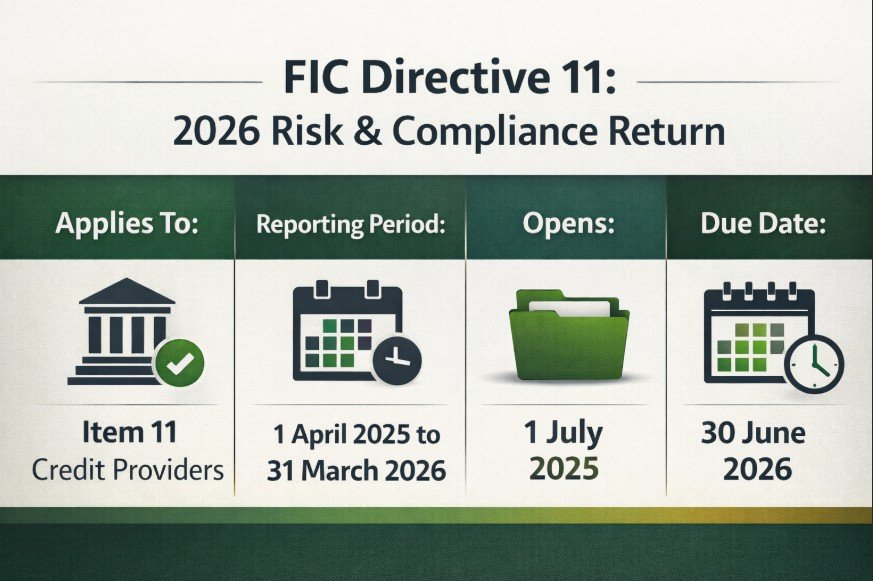
For affected item 11 credit providers, the 2026 risk and compliance return opens on 4 May 2026 and is due on 30 June 2026 by 17:00.
The reporting period runs from 1 July 2023 to 31 March 2026. That is the key FIC RCR deadline credit providers should be working toward now.
Conclusion
FIC Directive 11 for credit providers is more than a compliance update. It is a practical reminder that credit providers need to be clear on scope, accurate in registration, current in their RMCP, and able to show that their controls are working.
The businesses that will handle this best are the ones that prepare early, review their compliance position properly, and resolve weaknesses before the return has to be filed.
FAQ
What is FIC Directive 11?
It is the directive that sets the filing framework for the 2026 risk and compliance return for affected accountable institutions.
Does Directive 11 apply to credit providers?
Yes, it applies to affected item 11 credit providers, so businesses should assess scope carefully.
When is the 2026 RCR due?
The return opens on 4 May 2026 and is due on 30 June 2026 at 17:00 for affected credit providers.
Why does this matter from a risk perspective?
Because the return can expose weak classification, weak registration, poor implementation, or missing evidence if the business is not properly prepared.
Need support with Directive 11 readiness?
Nkwali Compliance Consultants supports regulated businesses with practical compliance assistance. If you need help with FIC registration, RMCP review, Directive 11 readiness, or broader credit provider compliance support, this is the right time to review your position.
Email: compliance@nkwalicompliance.co.za
Phone: 031 100 0988